The Fate of Poetry


Presented at the annual poetry meeting of the Chinese Writers Association in Da Li, Yunnan Province, China, on May 16, 2005. Translated into Chinese by Baolin Cheng.

We are here to discuss the “plight of poetry” and what is to be done about it. Our theme suggests that poetry is in trouble and perhaps losing its authority to communicate. This is a common theme in our time of mass media.

I don't believe that poetry is in any more trouble now than it was in 1798, when Coleridge and Wordsworth created English Romanticism with a single volume, The Lyrical Ballads, or the 12th century, when Ibn Sara wrote the beautiful poem “Eggplant” in the shape of an eggplant, or 1955, when Allen Ginsberg produced “A Supermarket in California.” Poetry is here to stay, and I see no social condition or historical upheaval that is likely to diminish it. Great wars come and go and poetry survives, acquiring new idioms along the way. Yeats made the point beautifully in “Lapis Lazuli”: “All things fall and are built again, / and those that build them again are gay.” The maker’s delight transcends the wrath of its time.

“Lapis Lazuli” was written one year before Yeats’ death in 1939, the year that World War II began in Europe. He knew the war was coming and looked straight through it, into time and the human personality.

The poet’s business is everything that exists. It’s a big job. He is no god and rarely a prophet, but he can trace the gods’ passing. Maxine Chernoff and I have been translating the work of Hölderlin, who desired contact with the gods and whose legend claims the gods destroyed him:

And let me confess

I approached to see the gods,
And they themselves threw me down beneath the living,
False priest that I am, into the dark, that I
Sing my warning song to those who can be taught.

(From “As When on Holiday . . .”)

The closest that most of us get to the gods is our experience of time: birth, love, aging, and death. We can feel the movement of time in the mirror, in the passing of seasons, and in the cadences of our poems. The poet’s business is sound engineering, time management, and painting in words.

I recently wrote that poetry resists experience, meaning that experience is transformed in poetry to something like fate. Something occurs in language that seems suddenly inevitable or “necessary.” Even in accounts of the everyday like Frank O’Hara’s famous Lunch Poems, poems are closer to myth than they are to experience.

We keep hearing that language is inadequate to the world. This is a sentimental notion. As Shakespeare, among others, shows so magnificently, language is perfectly capable of saying anything. Language doesn’t fail poets; poets too often fail the language. I read that the U.S. diplomat George Kennan was such an elegant writer that his boss, John Foster Dulles, asked a dull-minded diplomat to rewrite his memos so Dulles would not be too persuaded by them. Language, especially poetry, can capture worlds the world didn’t know it had. Wallace Stevens wrote that poetry “freshens experience.” It clarifies, elucidates, and unveils. Ironically, it can unveil by means of opacity and paradox.

In our country, perhaps in yours, there is a perceived struggle between traditional or folk values and commodity culture. Commodity culture is winning, and one reason is its manipulative use of language. The advertising culture persuades us to desire, and to possess things that we do not need. This is not news. The genius of our current administration has been to convince the average citizen that commodity culture is traditional value. The television news carries stories on how well the stores are doing during the Christmas sales season, as if that were important for us to know. The American avant-garde may be perceived as decadent—the excesses of the Beat writers like Ginsberg and Burroughs, for instance—but there’s a strong moral strain in such writing that opposes war, commodity culture, and the manipulations of mass media. The genius of the Beats is that they understood how to use the mass media to do so.

You can write a poem about anything. Every surface has its depth, for, as Emerson wrote, “Under every deep a lower deep opens.” In Gennady Aygi’s snowy fields, the wind ticks in a seedpod. We hear the experience across two or three languages, and we know what to feel. Even loss is a gain for poetry, because the “all” counts. There is no plight, no shortage of life. Despite the triumph of existentialism and the conditionality of truth, poetry always stirs back toward those essences where the indefinable lurks, and we have an intimation of that place and condition Hölderlin called “Abgrund.” Abgrund is the Ur-ground, or soil, from which everything else is generated. In English, we use the word “abyss,” which is misleading in suggesting a vast hole in the ground. Abgrund is the place of necessity and fate, and it is not to be toyed with. It is significance itself. Now and then poetry needs a fresh blast from it.

A Dante or Li Po doesn’t show up every day, and when they do we often don’t know they are among us. The plight of Emily Dickinson and Gerard Manley Hopkins was belatedness and invisibility—they died before their work was known. But today any serious reader of poetry in English knows them well enough. It’s the poets of smaller vision who are forgotten. William Carlos Williams’ influential volume Spring and All (1923) was published in an edition of only 300 copies. Only a handful of William Blake’s illuminated books were produced because, at the time, few people had any interest in them. Now they are among the great books of the world.

The fate of the poet is to exist both in and out of his own world. Keats felt a loss of identity when he watched some sparrows pecking about in the gravel. Imagination takes us out of ourselves. It layers and deepens experience. That’s the happiness of language, which gives us words as shadows of the things they represent, real things in their shapeliness, and finally the real shadows cast by the sun that inspire the word “shadow.”

The Rain: For Robert Creeley


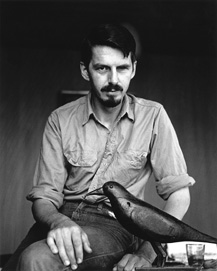
Photo by Harry Redl
www.harryredl.com


Maxine Chernoff and I first met Robert Creeley in Chicago around 1972. He was in town to give a reading at the Body Politic on Lincoln Avenue, the leading independent series in that city at the time. At a party in his honor, he was at the end of the hallway talking easily with that specific concentration of his, looking down as if at the thought itself then back at the person he was addressing. He spoke with us in the same manner, with no special agenda or ax to grind. He was the same person here as he was there, open and sincere. We walked away thinking what a nice man. Maxine was 20; I was 26. We were going to be poets and didn’t quite know what that meant. The lesson for us was that you can be a poet and behave reasonably, or as Bob himself would have said, “humanly.” Our daughter is named “Koren” after his poem “Kore”: “Oh, love, / where are you / leading / me now?”

I had seen Bob give a reading under Ted Berrigan’s sponsorship a couple of years before meeting him socially. Tall, affable, and angular, he decided to read one poem four or five times with different emphases and inflections. He was a little high, I think, the better to feel for us, but first to explore for himself, how elastic a syntax can be. You could learn more from one of his readings than a lifetime of prosody courses.

There’s a wonderful Harry Redl photograph of Bob in the Naked Poetry anthology of the late 60s, staring straight at the camera with one clear eye, one sunken and vacant, while before him on the desk stood the wooden model of a crow, turned sideways, with its one eye, and a half-filled whiskey glass. It was the most romantic portrait of a poet I’d ever seen, and it still defines him for me. Though highly posed, the image is not an imposture. He had his darknesses and discords, battling it out with Jackson Pollock at the Cedar Tavern, running away with Kenneth Rexroth’s wife even as the Beats were taking over Rexroth’s town of San Francisco. Naturally, Rexroth gave as well as he took in this department. Change was in the air. But whose change was it going to be?

No one wrote better love poems in our time than Robert Creeley, with all love’s intensities and disfigurements. Indeed, what sets him apart is not the originality of his technique, which was substantial, but rather his emotional intelligence. Here is his poem “The Rain”:

All night the sound had
come back again,
and again falls
this quiet, persistent rain.

What am I to myself
that must be remembered,
insisted upon
so often? Is it

that never the ease,
even the hardness,
of rain falling
will have for me

something other than this,
something not so insistent—
am I to be locked in this
final uneasiness.

Love, if you love me,
lie next to me.
Be for me, like rain,
the getting out

of the tiredness, the fatuousness, the semi-
lust of intentional indifference.
Be wet
with a decent happiness.

There’s a big difference between the early postmodern and ours of late; Creeley’s sensuous speech riddled with hesitation is one marker of it. He allows for matters of the heart. His obliquities do not tread inexorably toward parody, burlesque, and the exhaustions of theory. They are connected to the breath, to depths, to desire and the human occasion. He is all the more compelling for the guardedness of his vulnerabilities, that turn for instance at the end of his poem “The Whip”: “Ugh, / she said, beside me, she put / her hand on / my back, for which act / I think to say this / wrongly.” Is saying “wrongly” a form of love’s tact or confession’s brutal disclosures? Or is all expression inevitably skewed as representation? He wrote in the essay “Form”: “Being shy as a young man, I was very formal, and still am. I make my moves fast but very self-consciously.” This was the allure of Charlie Parker, whom Bob described as writing “silences as actively as sounds,” a good description of a Creeley poem. You can tell a poem by its rhythm from the other side of a wall. The emotional size of a poem is first announced through such sounding; it also leaves the most lasting impression. Creeley’s cadences are as distinctive as Thelonious Monk’s right hand, teetering and falling with an off-centered precision: Locate I / love you some- / where in / teeth and / eyes, bite / it but / take care not / to hurt, you / want so / much so / little.”

In the 90s, Bob and a Pulitzer Prize winning poet read at a Chicago benefit for our magazine New American Writing. The site was the old-line Union League Club, with its massive portrait of Ulysses S. Grant in the lobby. Bob was gracious about the setting, which had been arranged by one of our board members. The other poet told Bob that he had wanted him to win the previous year’s Pulitzer Prize in poetry but had been outvoted by others on the committee. Bob was gracious about that, too, but his insecurities came out when at a fancy restaurant he absolutely had to have a cheeseburger, fries, and a chocolate shake. And he was gracious when we teased him for having a “little kid” meal. Robert Creeley was one of our greatest poets of the last fifty years. His work was included in every major anthology of the same period, and he never received the National Book Award or Pulitzer Prize. This is a case of the prize being smaller than the man. He was gracious when a poet-critic at Northwestern University asked him which critic he most admired who did not care for his work. But later he asked, “What was that about?”

Most of us have been touched by Bob’s generosity: the example of his work, his availability, his blurbs on our books, his gift of continuity and idiosyncrasy. He was one of our gods. Without him, the world became immediately less familiar.

I’d like to end by reading my own poem dedicated to Bob, the last in a sequence called “Edge and Fold”:

XLIX

(For Robert Creeley)

never less than present
and close to the rain

summer’s in a rush
to wet its lips again

something calls us home
through the dim evening

a pair of hedge clippers
for those of us who dream

the exhaustions of infinity
will never touch us now

only gods die and the poor
love it well

what has always been
remains to be seen

memory’s last station
too many travelers


Presented as part of a Robert Creeley Memorial
University of San Francisco
11/7/2005